I was not aware of the Elmore family before I began researching our family history. We are descended from Louisa Elmore (1836 – 1901), who was my grandmother’s great-grandmother. I have enjoyed finding out more about this branch of the family and wanted to share what I have discovered. I have attached two family tree charts which show firstly where the Elmore family fits into my grandmother’s tree, and secondly, the full Elmore family as far as I have been able to trace them.
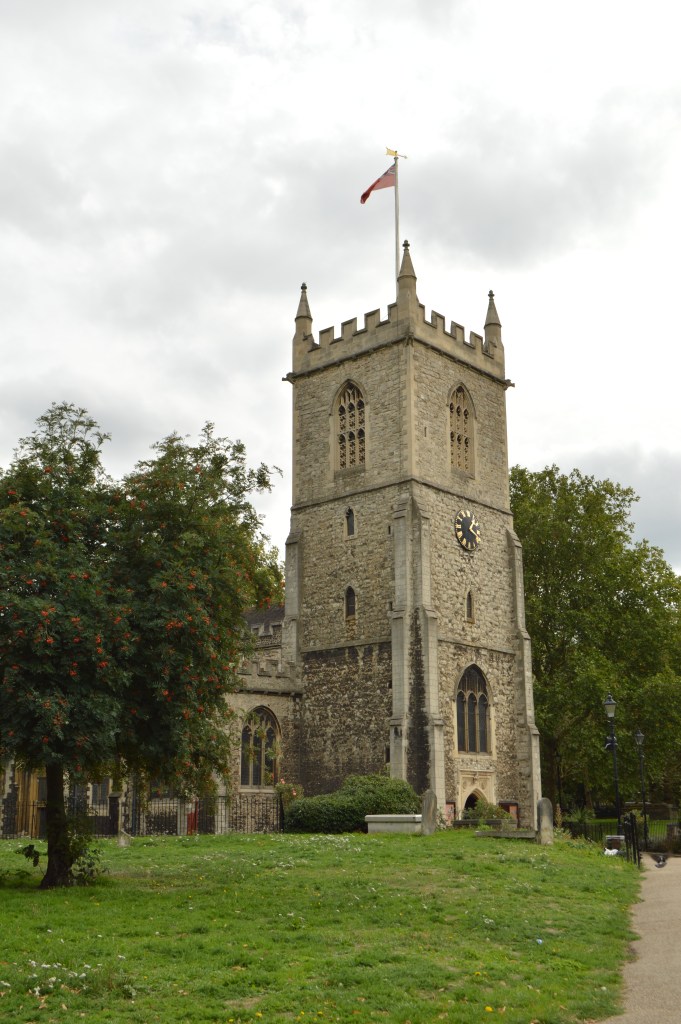
The earliest Elmore ancestor I have found is John Elmore (dates unknown), my 9 x great grandfather (NB parish registers sometimes spell the surname as Elmer, Elmar or Hillmore). John and his wife Mary (maiden name unknown) lived in Ratcliff in east London during the 1670s, where he was a mariner. John and Mary had at least two children, who were baptised at the parish church of St Dunstan and All Saints in Stepney; one of them, a boy, was presumably stillborn as he was buried without being given a name. Although I have not been able to find John’s own baptism, it is likely that he was originally from the east end of London as there are a number of other Elmore names in the parish registers of St Dunstan, some of whom died during the Plague of the 1660s. The church was the parish church of the British seagoing empire and still flies the flag of the merchant navy. Unfortunately no records of John’s career have survived so we do not know in what capacity he served.
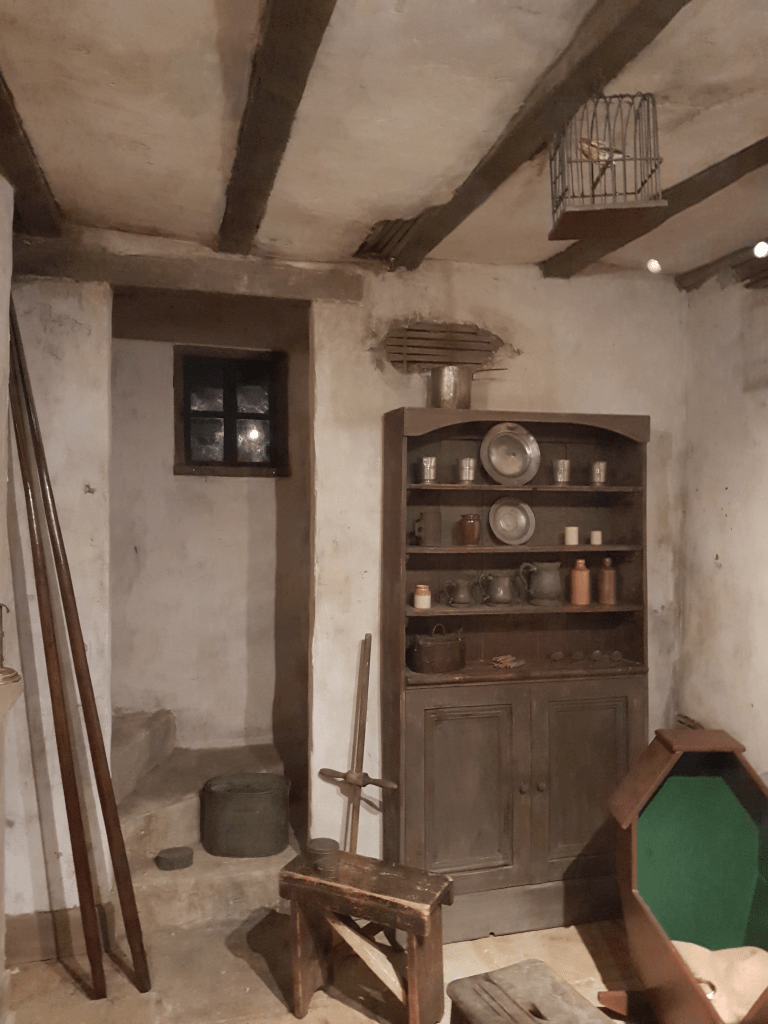
Ratcliff in the seventeenth and eighteenth century was part of an area of the east end known as “Sailortown”, close to where Canary Wharf sits today. It was a maze of alleys and lanes, full of ships’ chandlers, lodging houses, alehouses and brothels. The Museum of London Docklands has recreated some of these streets as part of its permanent display. It was common for seafaring occupations to run in families, and indeed, John and Mary’s other son, Henry Elmore (1671 – 1736) also served as a mariner. The family may have lived in a house like the one below.
Henry Elmore grew up in Ratcliff. He was married to Charity (maiden name unknown) and the couple baptised their five children at St Dunstan’s church in Stepney. Although no records of Henry’s career survive, we can piece together some of his life from his will, which confirms that he served in the Royal Navy. It would appear that he lived for a time in Ipswich, a naval port, as he owned and rented out a cottage there which later passed to his son Henry. It would appear that Henry Senior had been living at the Royal Greenwich Hospital for the last years of his life, possibly following Charity’s death in 1734. The hospital (more of a retirement home) had opened in 1692 and was for veterans of the Royal Navy who mainly came from poor backgrounds. The fact that he was there means that he had probably been wounded in some way during his service. This link gives some more information as to what life would have been like for Henry at the Royal Greenwich Hospital.
Henry and Charity’s eldest child, and only surviving son, was our ancestor Henry Elmore (1705-1757). Henry followed his father into the Royal Navy, but, rather than going to sea, he worked in the shipbuilding industry. Specifically, he was a caulker – sealing gaps in the hulls of ships to make them watertight. In July 1730, when he was 25 years old, Henry was working at the naval shipyard in Woolwich when he was one of a group of caulkers who effectively went on strike “whilst breaming and caulking the Falmouth. They claimed that water coming in through the dock gates had wet their feet, but Hayward [the Master Shipwright] says this was their fault as they were ordered to caulk the gates to prevent this” [National Archives]. Henry was fined a day’s wages for his part in the protest, the ringleader lost 3 days’ pay as well as his job.
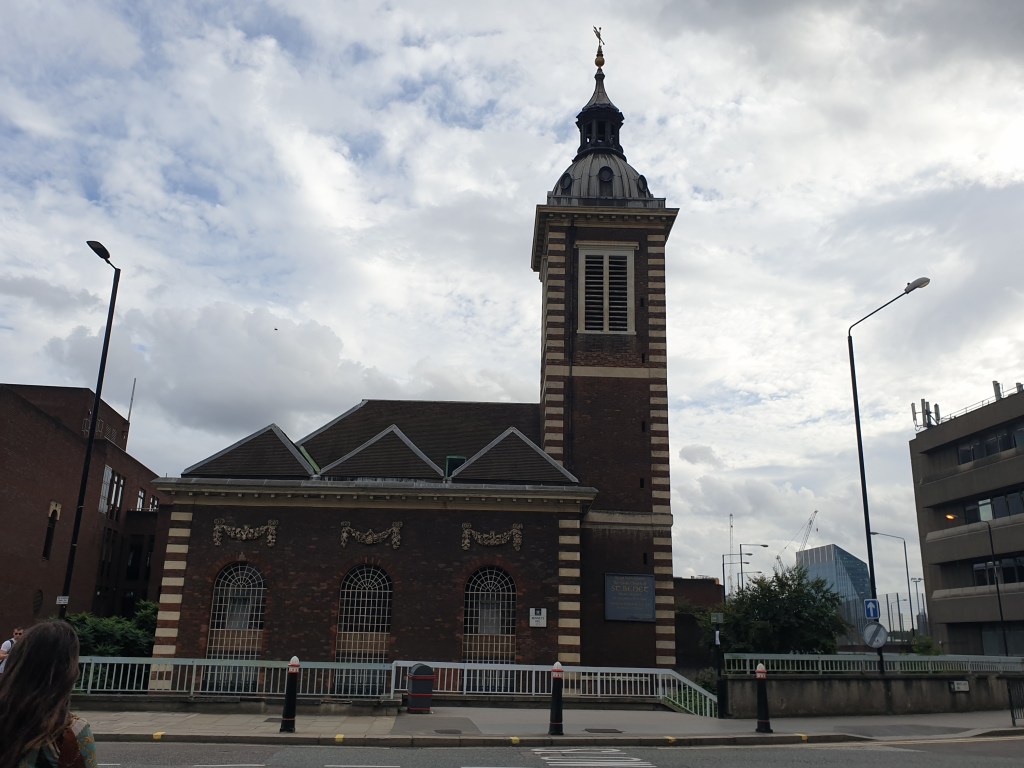
By June 1735, Henry had moved to the naval shipyard in Plymouth where he continued to work as a caulker. Documents held by the National Archives record that he had been granted leave to return to London but on his arrival had learned of his mother Charity’s death. Henry requested a transfer to the royal shipyard at Chatham to enable him to care for his “elderly father” (Henry Senior was 64). This was not a bad career move as Chatham was the centre of naval shipbuilding in Britain with over 500 naval ships built there over its 400+ year history. The request was granted in July 1735 and Henry returned home; his father died the next year. Presumably he had met Elizabeth Young (1707 – ?), a local girl, when he had visited Stepney on leave, as the couple married the next month at St Benet’s church. This church in London was often favoured by couples wanting to marry in a hurry as it was exempt from the reading of banns.
Henry and Elizabeth settled in Gillingham initially and had nine children. They moved to Chatham at some point. Henry continued to work as a caulker and trained up apprentices at the shipyard. It seems that he didn’t have much luck. In 1743, there is a record of a request from Henry for another servant “now he has been cleared of the charges” – there is no record of what these charges had been. Henry’s next apprentice, Robert Hutchins, started in 1743 but died in 1747 not long before his apprenticeship ended. Letters from the Commissioner at Chatham in 1747 record Henry’s request for another apprentice and the three-month delay before this was enacted.
Henry died in Chatham in 1757. His will shows that he was not wealthy, his household goods amounted to less than twenty pounds. As a result, only one of his children, his son Joseph, inherited anything – the cottage in Ipswich. Although there are no records of Joseph’s baptism, it is likely that he was Henry and Elizabeth’s oldest son. He also had a naval career, serving on three ships. Joseph was serving on the Harwich when she was involved in the capture of two French vessels, and also when the ship was wrecked off Cuba in 1760. Joseph then transferred to a depot (support) ship, the Ocean, where he served from 1760 – 1762. There appears to have then been a thirty year gap before he sailed again, on the prison ship, the Hero. He was admitted to the Royal Greenwich Hospital in 1798 having lost his left eye and with wounds to both of his arms.

We are descended from Joseph’s younger brother, the third of Henry and Elizabeth’s three sons, who was named Young Elmore (1745 – 1824) probably to maintain Elizabeth’s family name. He was the first of several Young Elmores as the name became something of a family tradition. Our Young Elmore was born and raised in Chatham and followed his father into the shipyard where he worked as a bricklayer, he lived in Cross Street just a few streets away. He would have been involved in work such as the building and repair of wharves and dock walls, as well as the various buildings and storehouses that formed part of the shipyard. Young had apprentices and was sufficiently well thought of that his daughter’s marriage was noted in the local newspaper in 1790 (below). By 1798 he was managing the bricklayers.

Young was actually married three times. His first marriage, to Ann Furner (1747-1779) bore five children, including another Young Elmore, and our ancestor Thomas Elmore (1773-1824). Ann died in 1779 at the age of 32, her youngest child was only a year old. Young remarried the following year and had a further five children with his second wife Catherine Bennington. Sadly, the couple buried their two youngest daughters in 1787, the youngest was only a few weeks old. When Catherine died, it made the local press:

Young remarried again in 1800, to Hester (or Esther) Wilson who outlived him. When Young died in 1824 he left a house in Chatham with a large garden, but like his father, the value of his other possessions came to less than £20.
Young and Ann’s eldest son, Young Elmore (1770-1856) also became a bricklayer at Chatham, having served an apprenticeship. He and his wife took the opportunity to try and enrol three of their sons in the Royal Hospital School at Greenwich which had been set up to help the children of impoverished seamen, but had recently expanded to educate children from other seafaring backgrounds. At least one child was rejected due to being over age.
Thomas Elmore (1773-1824) was the third of Young and Ann’s children and was born in Chatham. He married Elizabeth Carter (1768-1855). Strangely there is a record of their banns being read in London in 1786 but the marriage did not take place until 1791. Assuming that there was not another couple with the same names, it may be that Thomas had attempted to marry Elizabeth when he was only 13 years old. The couple lived in Chatham and went on to have at least five children. Thomas was a “house carpenter”, i.e. he was responsible for the woodwork of a building from the foundations to the roof, as opposed to a joiner who was usually more skilled and responsible for the more visible parts of the building. Thomas’s will was witnessed by someone based at the marine barracks in Chatham so it is likely that he worked there; this was the base of the Chatham Division of the Royal Marines from 1775. Thomas’s will provided for his wife and included the rent from various premises that he rented out, however his own possessions again were valued at less than twenty pounds.
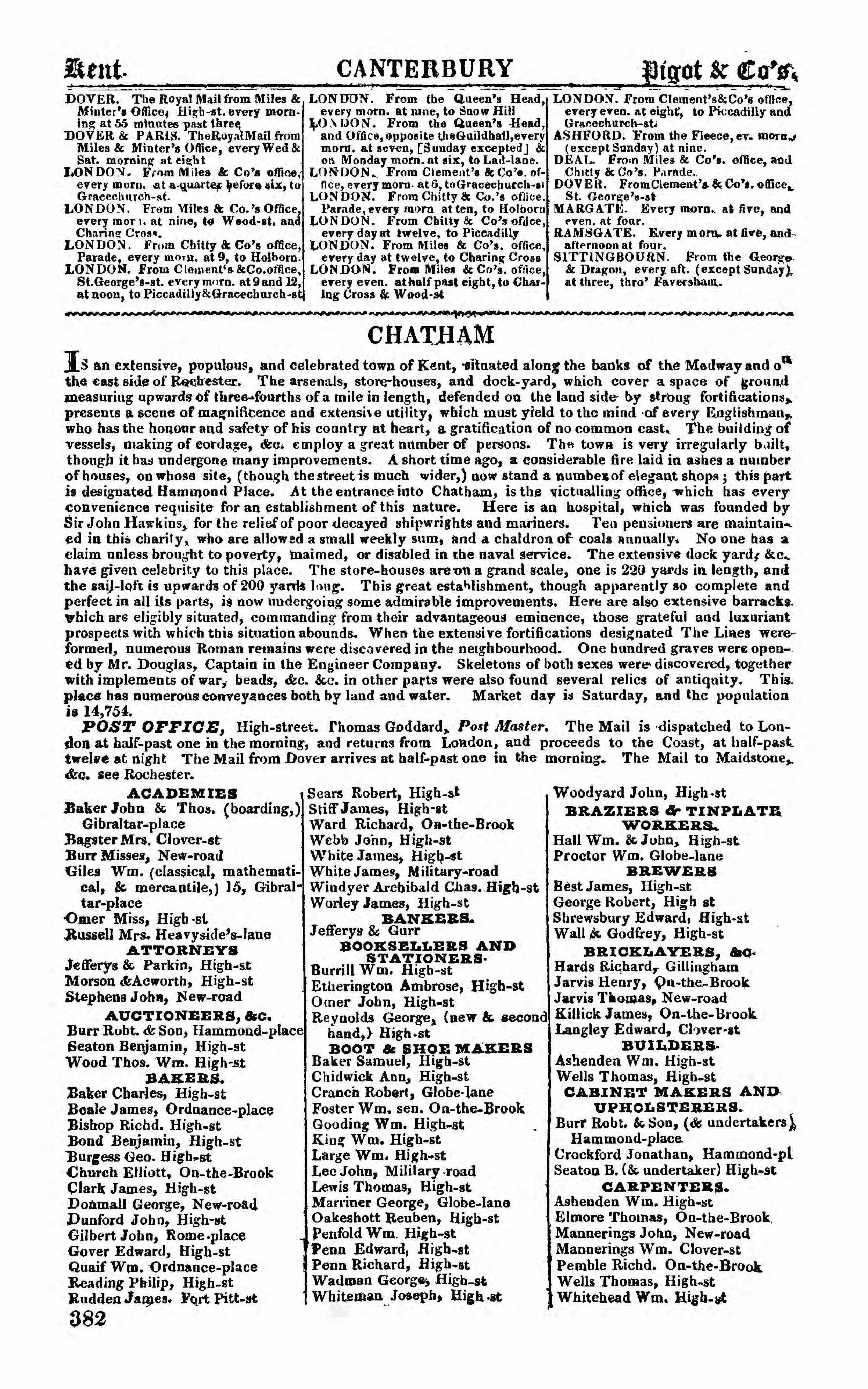
Our final male Elmore ancestor was Thomas and Elizabeth’s second son Thomas Elmore (1807-1847) (the eldest son being another Young). Thomas was also a carpenter, but it seems that, with him, the Elmore connection to the Royal Navy ended. He is listed in various trade directories (including the one attached from 1824 which gives a nice description of Chatham at the time), and appears to have lived and worked at The Brook, now the main road linking the shopping centre with the site of the Dockyard.
Thomas and his wife Elizabeth Louisa Pratt (1809-1853) had six children and remained in Chatham. We know little about their lives except that Thomas was twice the victim of theft. In 1835:

The second theft, ten years later, has an interesting story as set out below:
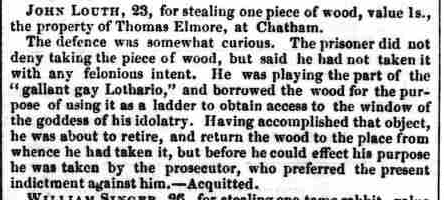
We can only assume that John Louth was acquitted because his tale was true and not because he acted his way out of the conviction!
This brings us to our final Elmore ancestor. Louisa Elmore (1836-1901) was Thomas and Elizabeth’s third child and youngest daughter. Like the previous three generations, she was born and raised in Chatham, baptised at the parish church of St Mary’s (now closed). At the age of nineteen she married Thomas David Lowdell (1835-1915) who was at that time a baker. I will write about the Lowdell family separately. The couple had five children and lived most of their lives in the centre of Chatham, moving further out of the town not long before Louisa’s death in 1901. Census returns do not record any occupation for Louisa so she would have kept the house and brought up the children while her husband provided financially for the family in his 40+ years working as a fish dealer. Even when the family moved away from its naval origins, the sea was central to our ancestors’ lives.
NB many other members of the Elmore family also served as mariners, both in the Royal and merchant navies but I have had to limit my focus to just our direct ancestors and a couple of their other children here!
 Butland Gooding Family Tree