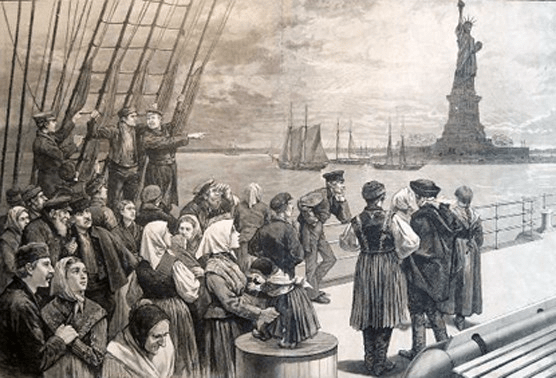
My grandmother’s great grandmother was Eliza Sarah Ann Wren (1842-1903). Like many of my grandmother’s family, she came from a long established Kentish family, with more recent generations working as carpenters at the Chatham dockyard. Eliza was the eldest of seven children born to William Wren (1818-1900) and Eliza Lucy Rudland (1816 -1865) in Chatham. Here I am going to focus on three of Eliza’s younger siblings, who all took the decision to leave not only Chatham, but Great Britain, in search of a better life.
The second half of the nineteenth century saw a huge increase in emigration as steam ships made travel cheaper and quicker. Opportunities were even advertised in Britain, as America, Canada and Australia sought farmers and skilled labourers to add to their populations. Wages were higher than in Britain and the idea of new beginnings, more money and space was hugely attractive to many.
In 1871, Eliza’s sister, Elizabeth Emily Wren emigrated to New York state with her husband Richard Cordingly. Richard had been working as a grocer in Chatham and the couple had lived above the Cordingly family shop. US Census records show that Elizabeth and Richard settled in the Finger Lakes region of New York State, specifically Milo, Yates County, and adopted a daughter, Susie, who was American by birth. Richard initially found work as a labourer, later becoming a fruit grower – the region is known for its wine. The couple became naturalised as US citizens in 1880 and remained in the same home on State Road, Milo for many years, eventually sharing the house with Susie’s own family.
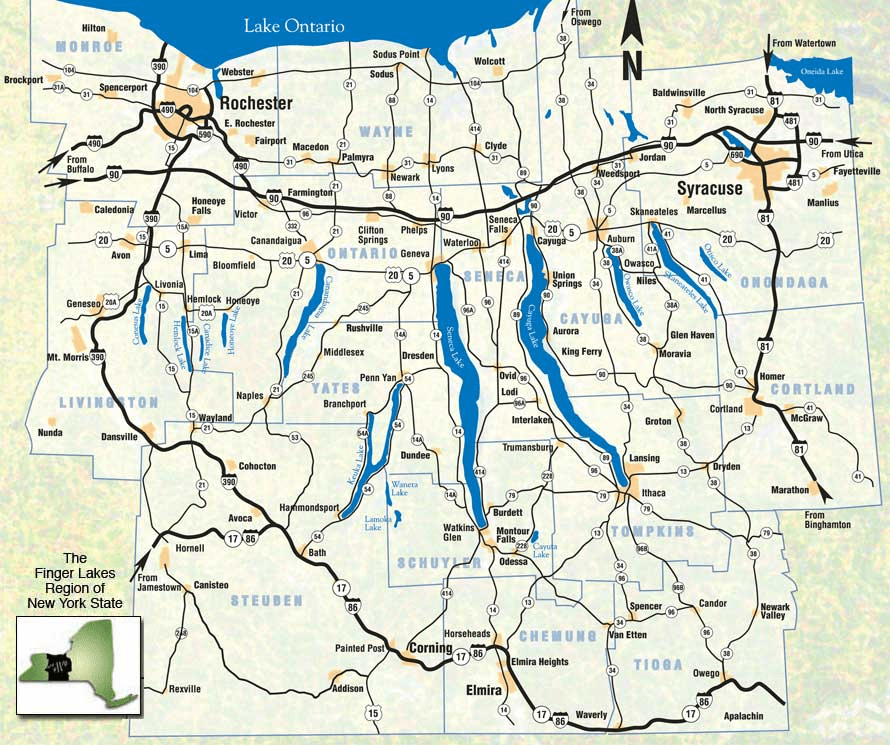
Reports back to England must have been positive, as Elizabeth and Richard were joined in the 1880s by two of Elizabeth’s brothers, Harry and Alfred. Richard later paid for his nephew, Albert Cordingly, to come to America, which he did in 1906. Albert actually married Elizabeth and Richard’s daughter Susie the following year although the marriage eventually ended in divorce.
The 1880s were a peak period of emigration to the USA from Britain. Henry Wren (1852 – 1932), known as Harry, probably travelled to New York in 1882. He worked on Richard’s fruit farm, and lived with his sister from when he arrived until his death at the age of 79. Harry never married and I haven’t been able to find out much about him.
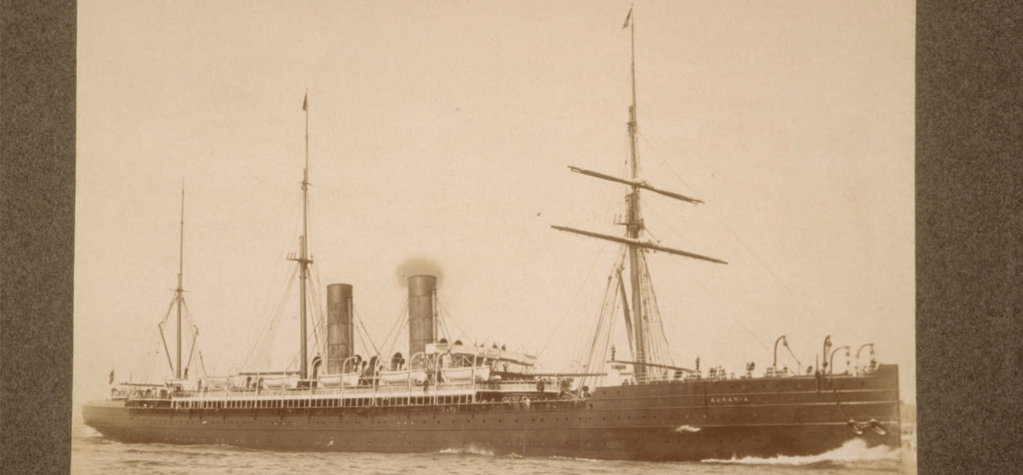
Much more information is available about the youngest of the seven siblings, Alfred Charles Wren (1856 – 1938). Alfred, his wife Emma and their four children left Liverpool in 1885 or 1886, arriving in New York after an arduous ten-day journey that saw the ship blown off course. Their youngest child, Arthur, was only around 10 months old and Emma may even have been pregnant again, as their daughter, Elizabeth Emma was born around 1886 in New York State. Three more children were to follow. The family lived with Elizabeth and Richard for six weeks before finding their own home in Penn Yan, Milo. A local newspaper report marking Alfred’s 80th birthday some years later includes Emma’s own recollections of arriving in the USA and how life in England had been before.
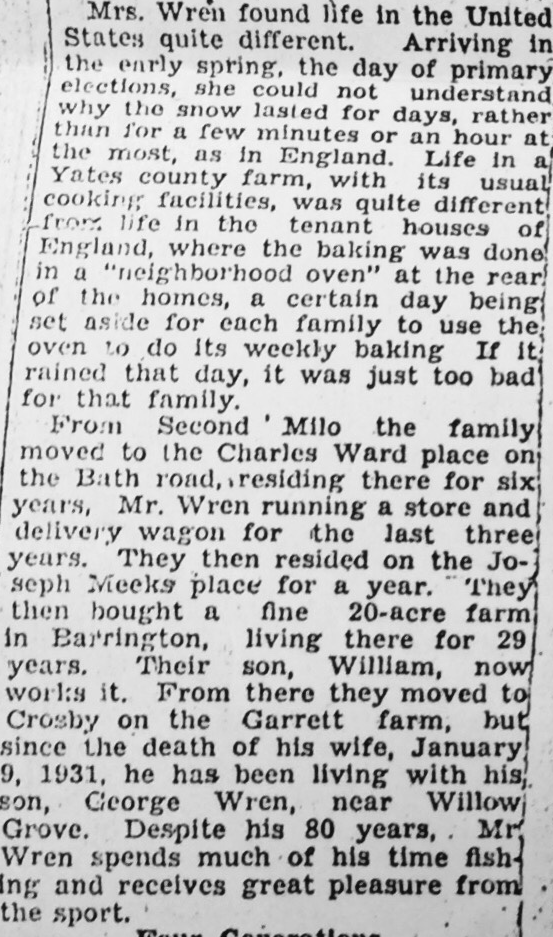
While in England, Alfred and Emma had lived at Rope Walk in Chatham, where Alfred worked as a labourer, probably at the shipyard. Alfred seems to have found work as a labourer straight away in America; he worked at Charles Ward farm on the Bath Road, and later ran a grocery store and delivery wagon as well. Alfred and Emma became US citizens in 1895.
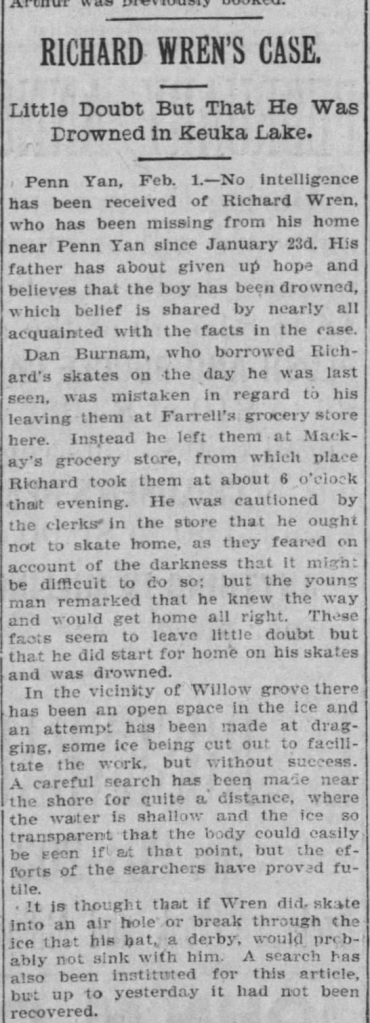
Four years later, tragedy struck the family. Local newspapers report how Alfred and Emma’s second son, Richard, failed to return home after skating on nearby Keuka Lake one winter’s afternoon in January 1899. He had just turned 18 years old. There was speculation that he may have run away to join the army but this seemed completely out of character. The more likely explanation was that he had skated into a hole in the ice near Willow Grove. Sadly his body was never found.
By 1905, Alfred had moved his family away from Lake Keuka to Barrington, south of Penn Yan, where he bought a 20-acre farm. Perhaps the location was chosen purely due to the opportunity it offered, but it may have been that a completely fresh start was needed for the family. Alfred and Emma remained there for 29 years before briefly moving to Crosby, back on the Lake. Emma died shortly afterwards, in 1931, and Alfred moved to Willow Grove where he lived with his son George until his death in 1938.
Alfred and Emma’s remaining children remained in New York State. Their son William went on to become Supervisor of Roads in Barrington before moving to nearby Dundee, Walter James became a grape grower, Arthur was a boat builder at Penn Yan Boats, George was Police Chief at Penn Yan and Fred was a Cabinet Maker. Although many of the female Wrens were based at home, Ethel moved to Ithaca and worked for Ithaca Leather Goods Co for over 20 years. She was fully part of the community and her thanksgiving dinner in 1917 even got a mention in the society pages of the local newspaper.
Although it has been reported that up to 40% of British emigrants may have eventually returned back to their home country, all of the Wren and Cordingly arrivals settled in New York State permanently, and their descendants remain in the United States to this day.
 Butland Gooding Family Tree

Hi Ruth Thanks so much for sending this – it’s fascinating reading. It’s interesting that we still have relatives living in America . I’ve often wondered about doing the Call the Midwife tour at Chatham dockyard – given our history, it would be interesting to visit that area too ( have you ever visited there ?) I hope you are all keeping well. Richard and I are currently planning holidays and breaks this year and would love to include Liverpool again if we can. You’d also be very welcome to stay here too ! Lots of love Rosie x
Sent from Outlook for Androidhttps://aka.ms/AAb9ysg ________________________________
LikeLike
Eliza Sara Anne wren married Frederick william overy ( 1838-92) at st Mary’s Chatham in 1861. They had 14 children of whom 11 lived to adulthood
Frederick was a leadman on the docks at Chatham
They were my great , great grandparents on my fathers side
It was great to learn more about other of the wren family
Susan daniels
LikeLike