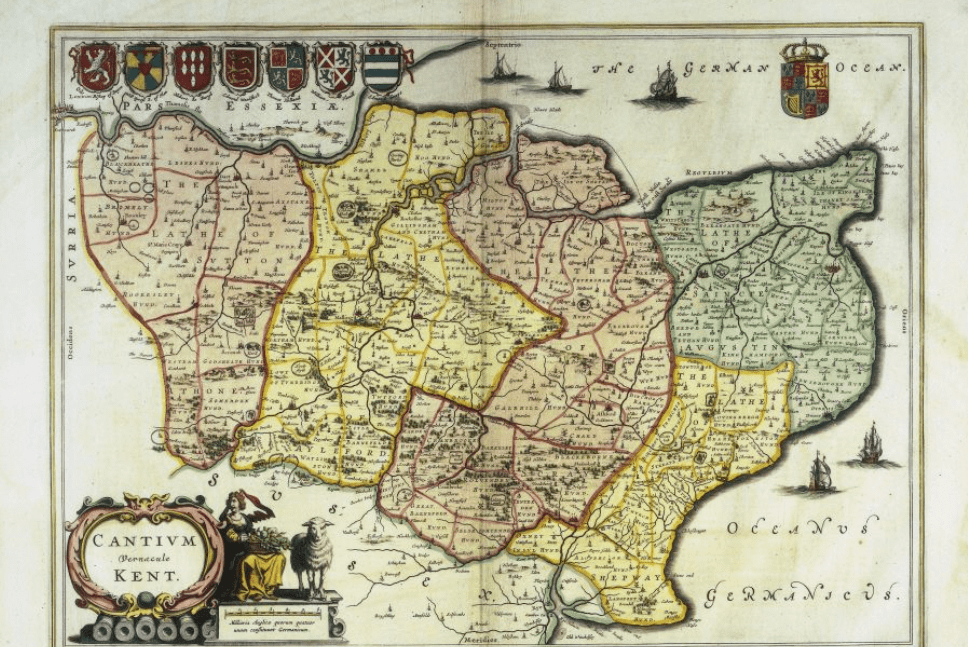
The Lowdell family from Chatham, Kent, were the ancestors of my grandmother’s maternal grandmother, Mary Ann Lowdell (1863 – 1925). While researching this branch of the family, I struck gold, as several of our ancestors over four generations left detailed wills which tell us more about individuals, their lives and relationships.
The Lowdell (or Lowdwell / Loudwell) family story – as far as I have been able to trace it! – begins with two brothers, Robert Lowdell 1 (? – 1641) and John (? – 1653). It is almost certain that the family were in the north Kent area for several generations prior to this as the surname can be found in many parish and other documents from the fifteenth and sixteenth centuries. Robert, our ancestor (my 11 x great grandfather), was probably born in the 1570s, he married Catherine Cassingale (1577 – 1615) in Bredhurst in 1603. The parish register notes that Robert was living in Aylesford and Catherine in Lidsing at the time. The couple had a son, Stephen Lowdell 1 (1605 – 1658) in Hartlip before moving to Chatham. Sadly their daughter, Elizabeth, died at only a few days old and Catherine also died the same week – Robert buried his daughter and wife within two days of each other. Five months later, Robert married again, and went on to have another daughter and another son, Robert Lowdell 2 (1618-1684), with his new wife. Robert 1 died in 1641 and was buried at the church of St Mary, Chatham.
Unfortunately I have not been able to find a will for Robert 1, but his brother John’s will was very detailed and has helped piece together family details, particularly helpful for confirming relationships between Lowdell family members around the North Kent area. John lived in Maidstone and also married twice, sadly only one of his three children survived him. John’s will tells us that his occupation was a freemason (probably a mason working with “freestone” i.e. a grainless sandstone or limestone suitable for ornamental masonry1). He owned a mansion house with stables and gardens in Maidstone, as well as six other tenements (houses) with back gardens which adjoined it or were nearby, between Weeke Street and St Faith’s Green. A map showing Maidstone in 1650 clearly shows where John’s own house and two of the tenements were situated:
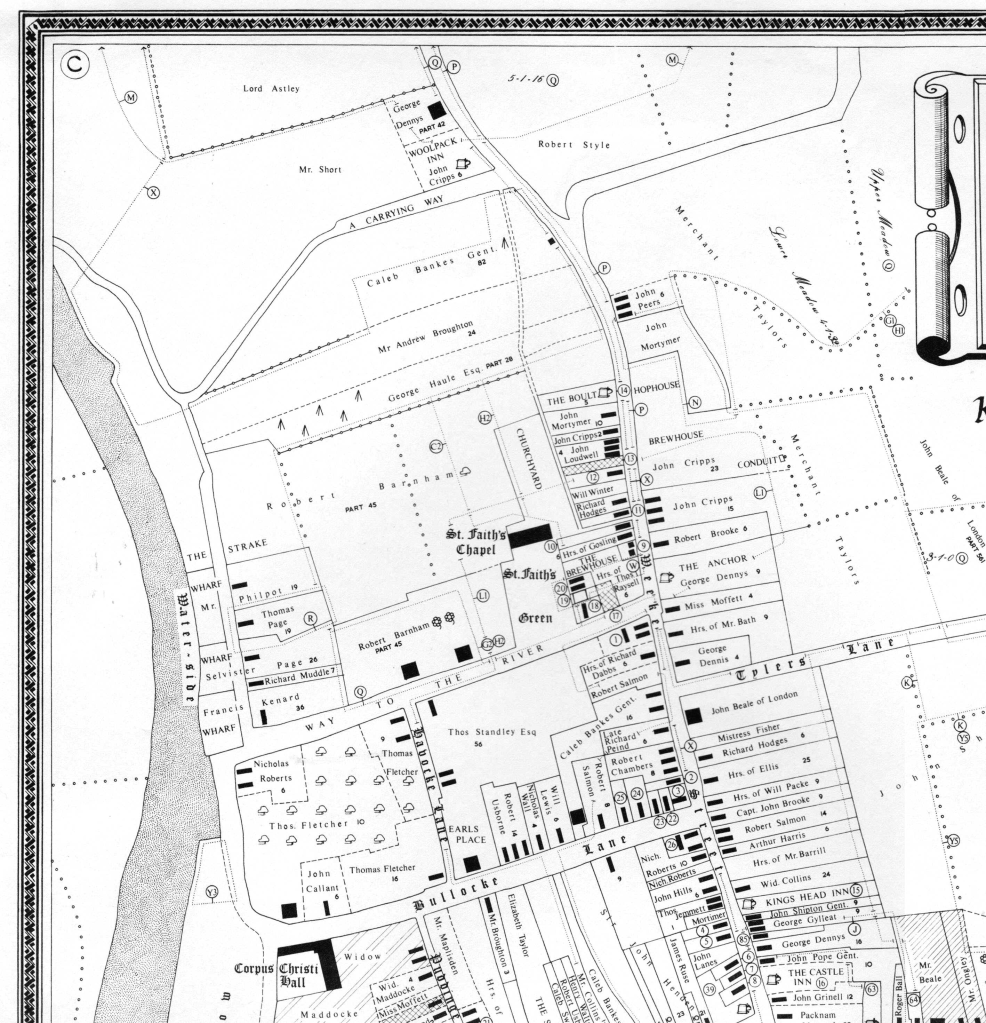
by Nicholas Wall. https://www.kentarchaeology.org.uk/research/tithes/maidstone#02a.htm
John left his estate to his wife and daughter, but asked his youngest nephew Robert 2 to act as guardian of his property and land, overseeing rents and ensuring that they did not fall into disrepair. Robert 2, a yeoman farmer living in Detling, was also to inherit the estate should John’s wife and daughter both die, but it would appear that this did not happen as Robert 2’s own will (1684) does not mention any land in Maidstone. I have been unable to trace John’s daughter Sarah any further but assume that she married and the land passed to her own children.
John’s will also tells us a bit about his standard of living. His wife Mary shared a bed chamber with their daughter Sarah, which John describes as “very well furnished”. He specifically bequeathed to Mary “one Feather bed, one Feather bed and bolster, one Feather pillow, Foure paire of sheetes, two pillow Coates, one Rugg and two blanketts and of the best Furniture”. A detailed inventory was to be taken of the rest of his belongings.
John also left some money to his older nephew Stephen Lowdell 1 (1605 – 1658), and to his seven children – twelvepence (1 shilling) each. It is likely that John favoured Robert 2 because Stephen would have been the main beneficiary of his own father’s estate; there is no hint of any animosity in John’s will. Stephen 1 was a yeoman who at the time of his death, aged 53, in 1658, owned land in Chatham, Stockbury, Gillingham, Lidsing, Capstone, Ridley Hill and West Rainham. His property included a farm (in Gillingham), 15.5 tenements, a cottage, barns, stables, orchards, woodland and many acres of land. Some of Stephen’s land may have been inherited from his mother’s family as well. Although Stephen did have some debts – his land in Stockbury as well as some of that in Chatham and Gillingham would be sold to clear them – there was plenty left to pass on to his children.
Stephen 1, like his father and uncle, married twice. He had four daughters with his first wife, Susanna Long. In 1648, six years after Susanna’s death, Stephen married Elizabeth Gardiner (?-?) in London, and the couple had two more daughters and a son. Stephen 1 was careful to differentiate between the children of his two marriages, ensuring that his older daughters received household goods that he had owned before his remarriage. Stephen 1 left land to each of his daughters, but as was the norm, the main beneficiary of his will, after his wife, was his only son, Stephen Lowdell 2 (? – 1696), who received his father’s home in Chatham, more than half of his land (mainly in Chatham and Lidsing) and specifically “the bedstead standing in the chamber over the parlour, one great chest in the same room & my great Bible”. Stephen 2 also inherited a dispute over some land in Ridley Hill (possibly near Sevenoaks) and was given instructions as to how to deal with it. Hearth tax records from 16642 show the widowed Elizabeth still in Chatham and taxed on three hearths at 2 shillings each. This was about the average number for a yeoman’s family.
Stephen Lowdell 2 (? – 1696) was also a yeoman, living on a farm in Chatham. He married Elizabeth Long (1652 – 1722) and the couple had four sons and three daughters. As well as the inheritance from his father, Stephen 2 inherited land in Chatham, Detling and Hartlip from his uncle, Robert 2 (1618 – 1684), who had been unmarried. Robert was not as wealthy, we know from Hearth Tax records in 1664 that he was taxed on the basis of only one hearth at his property in Detling. Robert 2 made provision in his will for his female servant, Mary Fryer, who was given all the profits from his property in Thurnham on the condition that she maintained it well. This was also to pass to Stephen 2 on Mary’s death – or sooner if she failed to look after it! Stephen 2 arranged for a large tomb to be erected for Robert 2 in Detling.
We know that Stephen 2 died of illness, probably in his forties. It would appear that something had gone wrong, or that he was not as shrewd as previous Lowdell generations had been as his brief will notes that “there are considerable debts”, as a result of which much of his land was sold. His wife Elizabeth was the sole beneficiary of the remaining farms, land and woodlands, all of which were in Chatham.
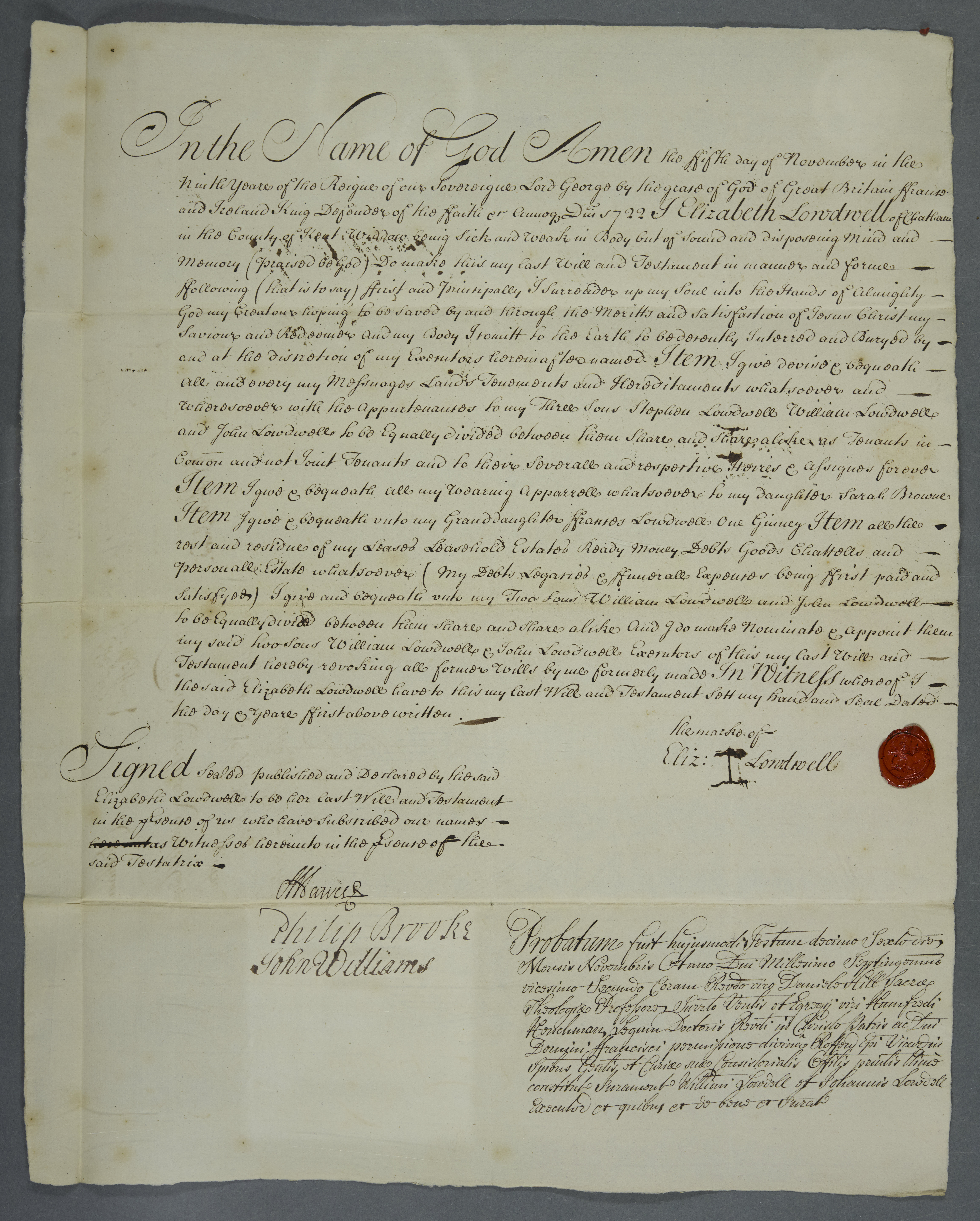
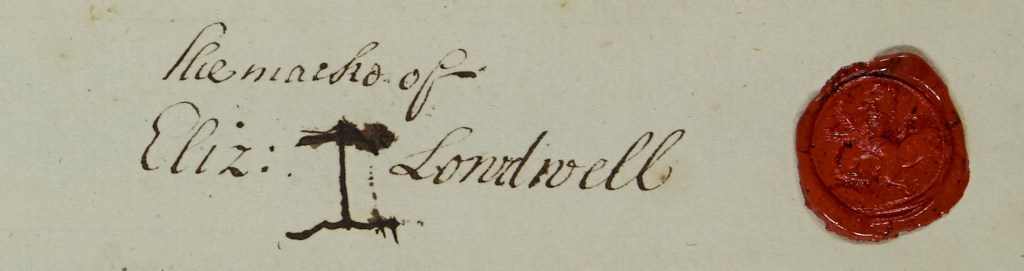
As Stephen 2’s will did not specify the division of property between his children, who were all under the age of 21 at the time of his death, it was left to Elizabeth nee Long (1652 – 1722) to determine this. She died in 1722, leaving all of the land to be split equally between her three surviving sons as “tenants in common” i.e. each with their own share. Interestingly, Elizabeth specified that all of her income from leases, her money and goods would go to her two younger sons rather than to Stephen Lowdell 3 (1675 – 1723), the oldest. We can only speculate as to why this may have been. Stephen 3 died the following year so it is likely that he was already ill, though his inheritance would have passed to his children at that point. Perhaps Elizabeth felt that Stephen 3’s younger brothers – a shipwright and a grocer – had more need of the income, Stephen 3 being a gentleman. Or perhaps there was a family rift; of Stephen 3’s eight children, only one, his eldest daughter, received anything in Elizabeth’s will. We will never know! The below extract from Elizabeth’s will shows that, even though she was a landowner’s wife, she was uneducated – as was common for women at that time.
As noted previously, Stephen Lowdell 3 (1675 – 1723) is recorded as being a gentleman of independent means, as early as 1699 when he married Elizabeth Yates (1673 – 1701) at around 24 years old. He had progressed to making money from the land he owned rather than farming it himself. Sadly, Elizabeth died less than two years later, and was “buried in woollen” in nearby Headcorn. This was in line with the law, though not everyone adhered to it. Five years later, Stephen 3 married Hannah Hooker (1682 – 1762), who came from another Kent landowning family. Stephen 3 and Hannah had eight children, four sons and four daughters.
Although Stephen 3 was already doing relatively well, he would have benefitted from his wife’s inheritance from her father, John Hooker (1642 – 1716) which included farms and lands in Mereworth. John Hooker left lands and tenements in Ightham to Stephen and Hannah’s oldest son, John Lowdell (1705 – ?). John Hooker also bequeathed the mortgage income from a house he owned in Chatham to Stephen 3’s “four younger children” – unfortunately the three further children born to Stephen and Hannah after John’s death missed out on an inheritance from their maternal grandfather.
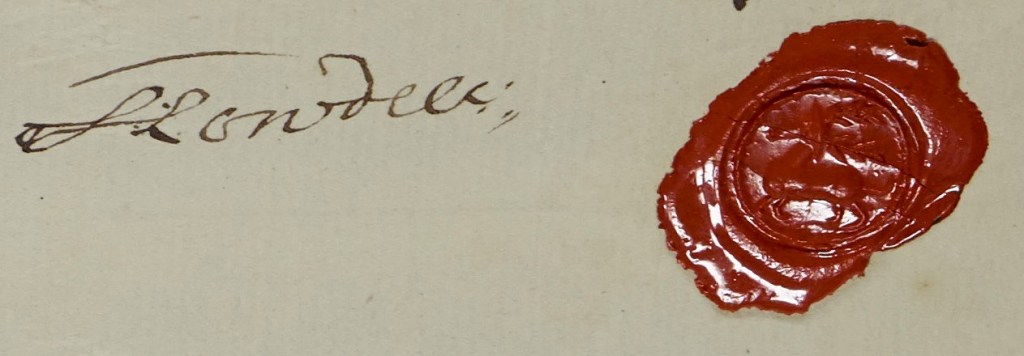
Stephen 3 died in 1723 at the age of 48, having also been suffering from illness. His will made provision for his wife, selling his share of the lands he had inherited from his mother so that the proceeds could pay any debts and support his family – his younger four children were all under the age of ten years old. All of Stephen 3’s lands were to be divided equally between his children, with the proviso that those who had already inherited from their grandfather would not receive more than the others. Stephen’s signature and wax seal survive as part of his will, see below.
It is at this point that the trail runs cold, as I have not yet been able to find wills for any of Stephen and Hannah’s children. We do not know how the land was divided up or how long any of it remained in the family. Our ancestor was Stephen and Hannah’s third son and fifth child, William Lowdell (1715 – 1755) who, by the time of his marriage in 1734 was living in Rochester. It may be that he inherited land there, but this would have been on a more modest scale, as future generations of the Lowdell family appear to have been more working class, with occupations including carter, shoemaker and fish dealer.
Sources
- Wikipedia – History of Freemasonry, accessed 5 September 2020 https://en.wikipedia.org/wiki/History_of_Freemasonry
- Tax Assessment Kent – Lady Day 1664, http://gams.uni-graz.at/o:htx.Kent#h_e47982
Wills are held by the National Archives (also available on Ancestry) – England and Wales Prerogative Court of Canterbury, and by Kent History Centre – Rochester Consistory Court. Any transcription errors are my own.
 Butland Gooding Family Tree