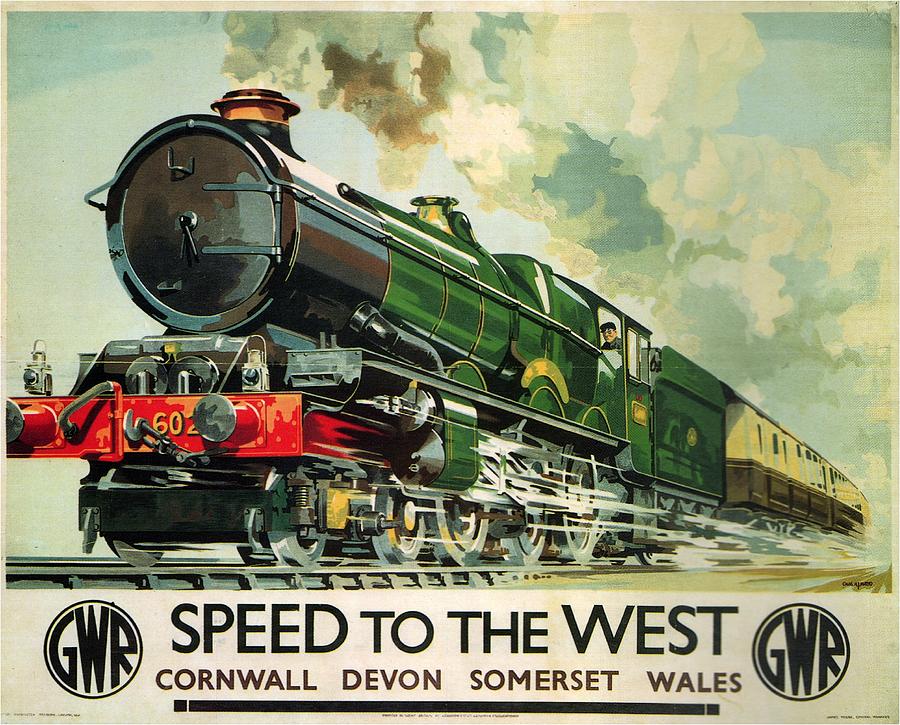
Growing up, I was aware that my grandfather, William Edwin Godfrey Butland (1909-2007) had worked for a period for the Great Western Railway, and held a lifelong love of steam engines. However, it has only been through undertaking my own research that I have discovered that the Butland family connection with the GWR actually went back 100 years prior to my Grandad, who was actually the last of four generations of Butlands to be employed by the railway company.
My Grandad’s great-grandfather, John Butland (1811-1878) was the first of the family recorded as working for the GWR. John was a stonemason who lived his adult life in Exeter. As a contractor, he would have undertaken a variety of jobs, however his most notable achievement was his work constructing railway bridges. John worked directly with Isambard Kingdom Brunel, the engineer who planned and built the Great Western Railway’s first line which ran between London and Bristol. John actually suffered from epilepsy which limited his work in later years, as he was not able to work high up. It is therefore likely that John’s involvement with GWR happened earlier in his life, possibly from when work on the railway began, in 1836. It should be noted that John’s father, Matthew Butland (1788-1863) and one of his brothers, another Matthew, also worked as stonemasons so it is probable that all three men were engaged in working on the railway construction project, although just a record of John’s involvement remains.
Only two of John’s five sons survived infancy. One, John James Butland, became a postman. The other, William Henry Butland (1844-1929), went on to have a long and successful career in the GWR. William was known as William Ellis Butland, the name given to his older brother who had sadly died as baby (Ellis being his maternal grandmother’s maiden name). He trained as a carpenter and joiner and was already working in this field by the age of 17. It is possible that he had a brief career in the Merchant Navy but deserted at Falmouth in 1867. At some point in the 1870s, William Ellis starting working as a railway carpenter around Bath, and entered the employment of the GWR in August 1877. His employment records show that by 1888, he was earning 8/6 per day. He also had some responsibility within the organisation and was probably managing a number of staff, as the below article from 1885 shows.

In December 1897, William Ellis was appointed Inspector of Mechanics. This required him to move with his family to Wolverhampton, where he was in charge of the “new works” at Hockley, the main goods depot in the midlands area. Hockley station was on the GWR line from Paddington to Birkenhead and it is likely that William Ellis was involved in the work to increase the number of railway lines between Hockley and Handsworth, as well as partially rebuilding the station. In 1903, William Ellis was appointed Bridge Inspector, a role that involved him maintaining and occasionally demolishing some of the bridges that his father had built. It also required some international travel including Mexico, Chile, Peru and Egypt. By 1913, his daily pay rate had increased to 11/- per day. William Ellis was finally transferred to GWR salaried staff in 1918 with pay of £175 per year for his role as Inspector of Railway Civil Engineering Works, but retired the following year, receiving both a GWR and state pension.
All three of William Ellis’s sons followed him into the GWR. We are descended from the middle son, John Isaac Butland (1876 – 1963). I have written about the careers of John’s brothers William Enoch Butland and Edwin James Butland in a separate blog.
John Isaac Butland first started working for the GWR in 1890, when he was 14 years old. His first job as a messenger at Taunton station lasted only 4 months, and he resigned in July of the same year. The following year, he was back at Taunton, working as a carpenter for GWR as his father had done. When the family moved north to Wolverhampton, John Isaac retained his GWR employment and continued working as a carpenter.
John married in Wolverhampton and had his first child there before moving south again. By 1907 he was a Clerk of Works in Bristol, a role that would have involved inspecting the workmanship, quality and safety of work on railway construction sites and ensuring that plans were being followed correctly. He remained in this role for several years and at some point joined the trade union, The National Union of Railwaymen (formed in 1913).
By 1921, John Isaac was working as Inspector of Mechanics at Plymouth’s North Road Station, though his work over the next few years also saw him overseeing the maintenance of other stations on the western line. In 1930 he was appointed to the role of Inspector of Mechanics at West Ealing station, despite having the same job title, this was a promotion for him.
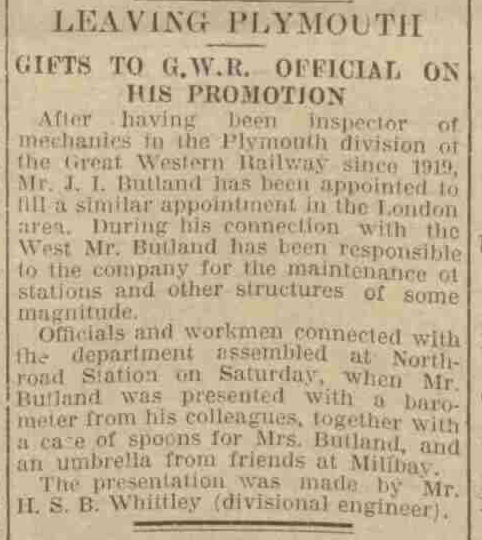
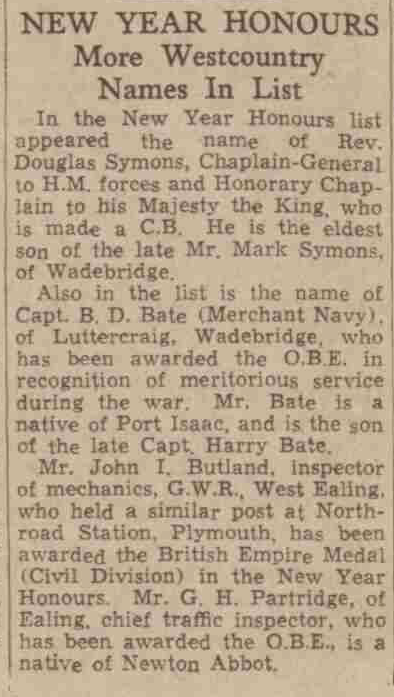
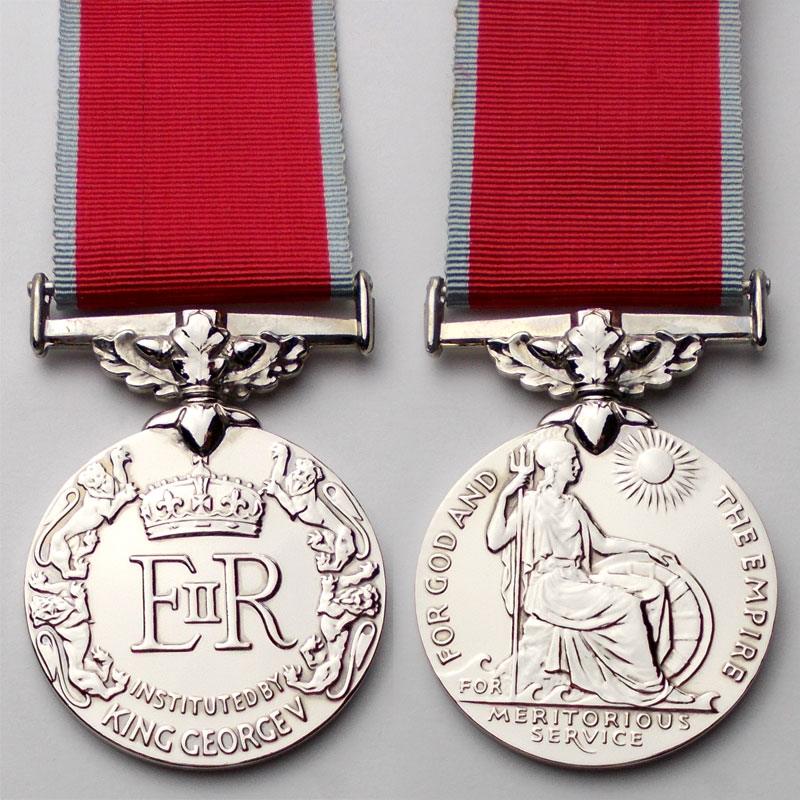
The family remained in Ealing and the 1939 register shows John Isaac living at 6 Drayton Road with his wife and son, my grandfather. This was just around the corner from West Ealing station. John Isaac was now a Railway Maintenance and Repairs Inspector in the Civil Engineers department of the GWR, and was also volunteering as an air raid warden. At this point, air raids had not yet started, but he would have been responsible for registering everyone in the area he was responsible for, and enforcing adherence to the blackout. Ealing was not as heavily bombed as some parts of London, but there were bombings in the area. Fortunately Drayton Road and the immediately surrounding streets escaped unscathed. In 1942, John Isaac received the British Empire Medal for services to Civil Defence, it is unclear whether this was for his work as an air raid warden or for his day job, railway staff being classed as essential workers during the war.
The last of the four generations of Butlands to work for the GWR was my grandfather, William Edwin Godfrey Butland (1909-2007) (known as Joe Butland), the son of John Isaac. Joe had only a brief railway career, working in 1939 as a New Work Surveyor in the Civil Engineering department – the same department that other family members had worked in, including his father. He also worked as a draughtsman, making detailed technical plans or drawings. However, he left the GWR in the 1940s and had a complete career change, training instead to be a vicar in the Church of England. Steam trains remained a passion however, and he had paintings of steam trains at home throughout his life, as well as visiting railways on holidays.
These four generations were not the only Butlands to work for the GWR however. I have written a separate blog about the other descendents of William Ellis Butland, some of whom had particularly distinguished railway careers.
 Butland Gooding Family Tree
I have read your information about the Butlands with great interest as I am related to them too. William Ellis Butland was my Great Great Grandfather and I am descended via his daughter Hettie Charlotte Butland who was my Great Grandmother ( your John Isaac Butland’s sister) and married James William Wood Murdoch ( I wear her wedding ring to this day as my wedding ring) I have many photographs of the family, all of which I have uploaded to ancestry so that they are available publicly. Any uploads attributed to Michelle will be directly from me. There is also an extensive family tree ( I trained as an archaeologist so have added nothing that I am doubtful about) I also have a family papers, photos and two family bibles which you may be interested in.
Regards
Michelle
LikeLike