It has taken me many years to find anyone famous within our family history, but research into our Stephens ancestors from Gloucestershire led to the discovery of a noble line dating back to Norman times.
Airard Fitz Stephen (or Stephen Fitz Airard), my 29 x Great Grandfather is thought to have been born around 1036 and may have been from the famous French de Blois family though this has not been confirmed. The use of “Fitz” did not denote royalty, as it was later used in England, but probably meant “son of”. Airard was definitely a nobleman however, and was a key part of the Norman invasion of England.
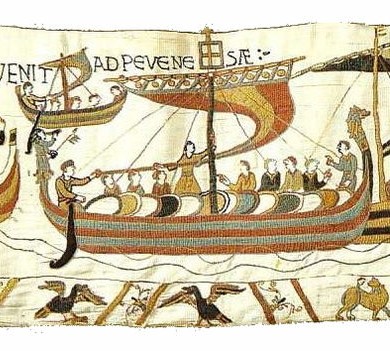
Edward the Confessor had designated his cousin Duke William of Normandy as heir to the throne of England but on his death, in January 1066, the throne was seized by the Saxon Harold Godwinson. William assembled a fleet of over 1000 ships and set sail for England. The largest and fastest of William’s fleet, and the first to arrive on English shores, was the warship named the Mora, captained and steered by no other than Airard. Including William and Airard, the ship probably carried around 10 Norman knights plus their entourages and equipment. The ship successfully landed at Pevensey, East Sussex, on 28 September 1066, and the invasion began. Airard remained in England where he was part of the Norman army that fought and won at the Battle of Hastings on 14 October 1066.
We know little more about Airard’s career, but he was well thought of by William, and remained loyal to him. The now King William I gave Airard lands in Hampshire, Berkshire and Warwickshire in recognition of his efforts, it is likely that land in Gloucestershire also formed part of his reward. He remained captain of the Mora until William died in 1087, but we do not know when Airard himself died, or where he was buried as he would have spent time in both France and England.
Airard was already married before the Norman Conquest, and had at least one child, a son called Thomas (? – 1120), my 28 x great grandfather.
By 1120, William I’s youngest son Henry I was on the throne of England and the Fitz Stephen family continued to move in royal circles. Airard had owned another, brand new, ship called la Blanche-Nef or the White Ship which his son had just refitted. This ship was docked at Barfleur, Normandy and Thomas offered it to the King to use for his return to England following a time of battle with Louis VI of France.
Thomas is said to have approached the king with the words: “Stephen, my father, served yours all his life by sea, and he it was who steered the ship in which your father sailed for the conquest of England. Sire king, I beg you to grant me the same office in fief: I have a vessel called the Blanche-Nef, well equipped and manned with fifty skilful mariners.”1
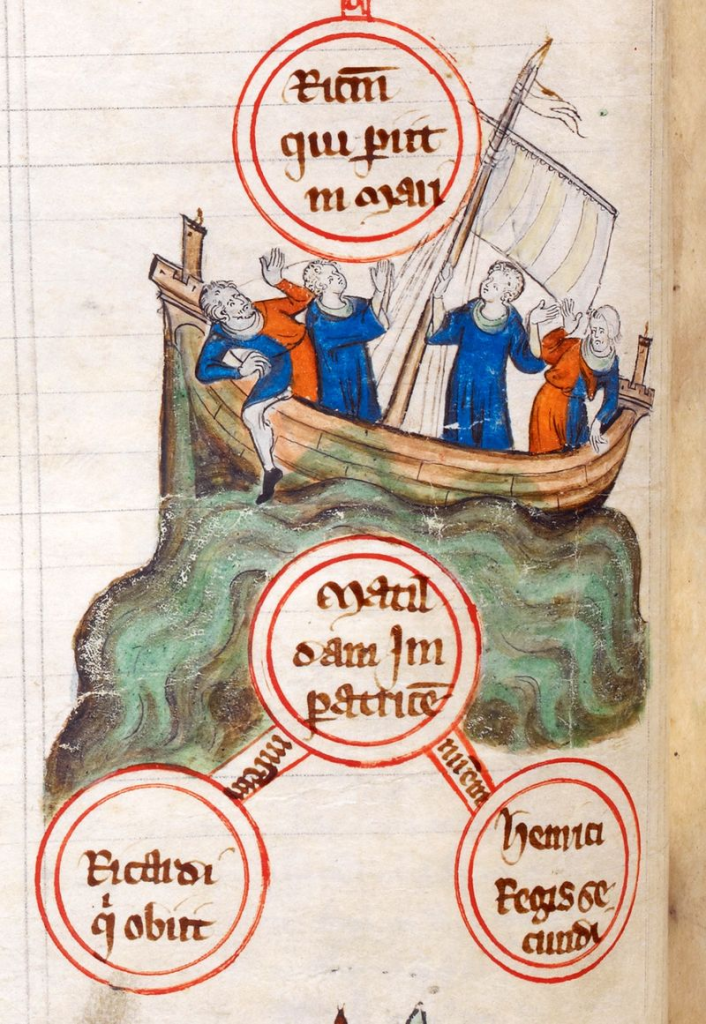
Although Henry made other arrangements for himself, he agreed that his sons would travel with Thomas, and in total around 300 people were on the ship when it set sail on the evening of 25 November 1120, including many other members of leading Norman families. Accounts of the events state that those onboard had been drinking excessively, the wine supplied by William Adelin, the only legitimate heir to the throne. The passengers urged Thomas to try and overtake the King’s ship, but in doing so, the Blanche-Nef hit a rock in the dark and capsized. William Adelin drowned while trying unsuccessfully to save his half-sister Matilda, and his half-brother Richard also died. In 1880, the poet Dante Gabriel Rosetti told the story of the tragedy from the perspective of a butcher who survived the shipwreck, noting:
“…we looked and knew Fitz Stephen there. He clung, and “What of the Prince?” quoth he. “Lost, lost!” we cried. He cried “Woe on me!” And loosed his hold and sank through the sea.”
According to Berold, the butcher, Thomas’s last words were “then it is terrible for me to live”. The ship was lost only half a mile off the French coast where it remained, however experts now believe they have found it following a diving expedition in the summer of 2021.
Berold was the only survivor of the white ship and the events led to a succession crisis for England’s monarchy. Airard and Thomas Fitz Stephen each changed the course of English history.
1 https://en.wikipedia.org/wiki/Thomas_FitzStephen
Sources
Stevens Genealogy. Some descendants of the Fitz Stephen Family in England and New England, Charles Ellis Stephens (1905)
An Outline History of Henry I (part II), The English Historical Review, Vol 34, No 136 (Oct 1919)
https://en.wikipedia.org/wiki/Mora_(ship)
https://en.wikipedia.org/wiki/White_Ship
https://en.wikipedia.org/wiki/Thomas_FitzStephen
https://www.normandythenandnow.com/no-ship-ever-brought-so-much-misery-to-england-from-barfleur/
 Butland Gooding Family Tree